
Apr 02, 2024
Leave a message

Apr 02, 2024
Leave a message
OLT: Optical Line Terminal, ONU: Optical Network Unit. In optical fiber networks, they are two very common devices, both of which play important roles in the application of optical fiber networks. However, there are subtle differences between OLT and ONU. Many people are confused about the difference between the two. Next, I will share with you the common question "OLT VS ONU" and help you better understand and choose the appropriate optical line terminal equipment.
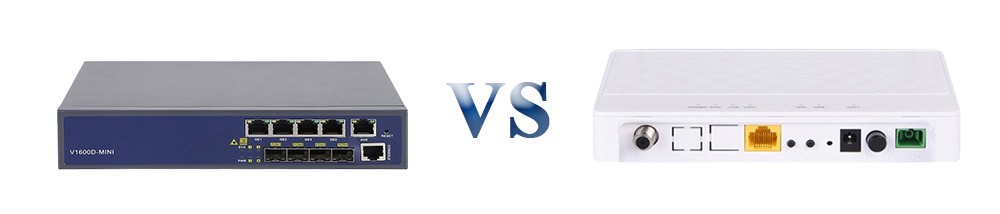

OLT (Optical Line Terminal)
Is the core device of the optical fiber network. It is usually deployed at the central node of the network and is responsible for centralized management and control of network traffic. It interacts with the upper layer network and transmits data traffic from the upper layer to the ONU.
ONU (Optical Network Unit)
Is the terminal equipment of the optical fiber network. It is usually deployed on the user side and connects to end-user equipment, such as computers, routers or fiber optic modems. It implements photoelectric conversion of optical signals and converts optical fiber signals into electrical signals for Terminal device usage.
OLT (Optical Line Terminal)
Responsible for the management and control of the entire optical fiber network, including configuration, monitoring, fault location, etc., such as:
1. Send Ethernet data to ONU (Optical Network Unit) in broadcast mode;
2. Initiate and control the ranging process, and record ranging information;
3. Allocate bandwidth to ONU; that is, control the starting time and sending window size of ONU to send data.
ONU (Optical Network Unit)
Only responsible for communication with end-user devices and does not involve the management and control of the entire network, for example:
1. Choose to receive the broadcast data sent by the OLT;
2. Respond to the ranging and power control commands issued by the OLT; and make corresponding adjustments;
3. Cache the user's Ethernet data and send it in the upstream direction in the sending window allocated by the OLT."
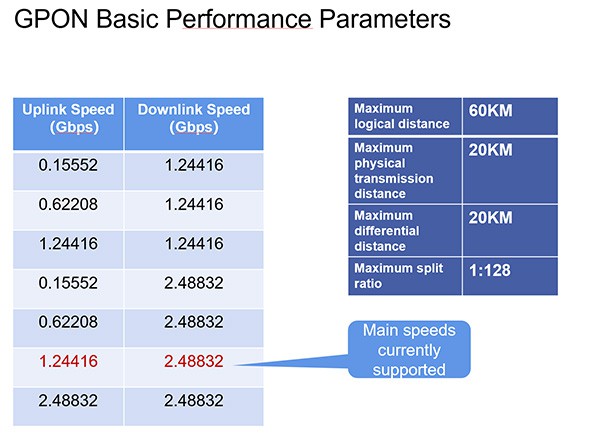
The maximum logical transmission distance of OLT is 60km, the maximum physical transmission distance is 20km, the maximum differential distance is 20km, and the maximum transmission rate can reach 2.48832Gbpsx
The maximum logical transmission distance of the ONU is 300m, the maximum physical transmission distance is 100m, and the maximum transmission rate is 1.24416Gbps."
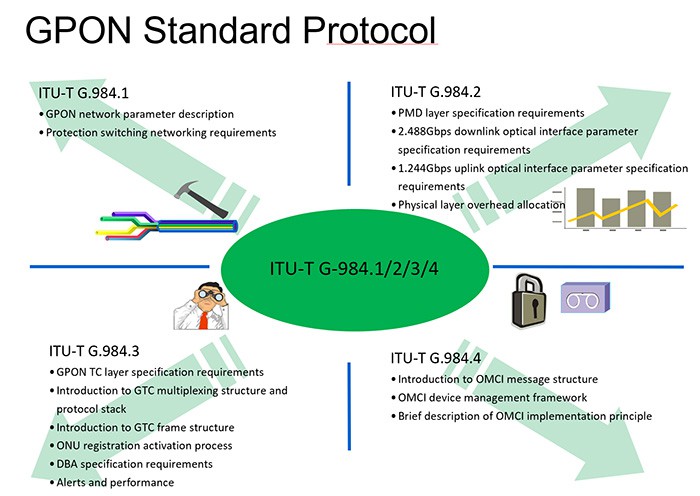
ITU-T G.984.4 international technical standard, including an introduction to OMCI message structure, OMCI device management framework, and a brief description of OMCI implementation principles.
GPON adopts a point-to-multipoint networking architecture. There is only one optical fiber from the PON port of the OLT to the ONU. In order to achieve one-way and two-way transmission, GPON uplink and downlink signals use different wavelengths. The wavelength of the uplink signal is 1310nm, and the wavelength of the downlink signal is 1490nm.
GPON adopts a point-to-multipoint networking architecture, copying and broadcasting downlink data to each ONU. The ONU filters the data according to the gemport ID information contained in the data packet header, forwards only the data belonging to this ONU, and discards other data."
FTTH Triple play service configuration Triple Play refers to providing multiple different service access methods on one user line at the same time, such as Internet services, VoIP services, IPTV services, and even CATV services, etc.
In terms of user scale, the size of the cabinet and the different configurations of the OLT can support the optical access network broadband needs of hundreds to tens of thousands of people. The uplink access bandwidth of OLT has increased from 1.25G to 10G. Currently, many regions and countries are expanding to 100G access bandwidth.
Has been expanded from the initial WIFI3 to WIFI6, from the initial APON, BPON to EPON, then to GPON and XPON. Currently, XGPON and XGSPON are also being iteratively upgraded and popularized.
Is usually deployed in the core or node computer room to aggregate the business data of the optical access network and distribute it to different IP networks. For example: schools, hotel computer rooms, operator cabinets, project data centers, etc.
Is usually used in corridors, aisles, rooms, weak current rooms and other scenarios. In order to meet the needs of various scenarios, ONU equipment also comes in various forms, such as: 86 panel type, desktop type, SFP module type , ceiling type, rack type, etc.




All in all, OLT and ONU both play a very important role in the optical fiber network. Each has unique functions and application scenarios. Understanding the difference between OLT And ONU is crucial for the correct selection of optical line terminal equipment.
If you still have questions about the selection of optical line terminal equipment, or need more technical support and consultation, please feel free to contact Asahikawa. As a professional optical line terminal manufacturer, we look forward to providing you with the best solutions and help You build a high-speed, stable fiber optic network.