
Dec 16, 2024
Leave a message
Dec 16, 2024
Leave a message
As the core equipment of optical fiber access, the importance of optical line terminal (OLT) is unquestionable. Traditional OLT has high stability and maturity, and has always been the preferred equipment for network deployment of major operators and enterprises. However, with the continuous changes in user needs and the improvement of network performance requirements, the network management system of traditional OLT equipment has gradually shown some limitations. In such a context of increasing demand, the intelligent OLT system came into being. The intelligent OLT system integrates many advanced technologies and has become an important pillar of the new generation of network architecture.
OLT, short for optical line terminal, is the core device in the optical fiber access network. It is responsible for distributing the received data to the user terminal (ONU or ONT) and aggregating the data to the core network. As an important part of the optical network, OLT has multiple functions, including signal conversion, bandwidth allocation, network management, etc. Traditional OLT is usually based on a fixed hardware architecture, and its design goal is to achieve stable and reliable data transmission and meet basic network access requirements.
Smart OLT, as the name implies, is an upgraded version of the traditional OLT equipment. It is a product based on the functional evolution and technological innovation of the traditional OLT. It optimizes the hardware architecture and introduces advanced technologies such as artificial intelligence, big data analysis and cloud computing. The new design concept of the smart OLT system enables the smart OLT to not only meet the high-performance requirements of the modern network environment, but also reduce operation and maintenance costs, expand the compatibility and interoperability of equipment, and improve business flexibility and network reliability.
Traditional OLT adopts fixed hardware architecture design. The realization of various functions depends on dedicated hardware devices. Upgrading and expansion often require replacing the entire hardware, resulting in poor flexibility.
Smart OLT realizes modular deployment through software and hardware decoupling design, supports virtualization and cloud technology, so it can quickly realize function upgrades through software updates, has extremely high flexibility, supports automatic optimization of network parameters, and can dynamically adapt to diverse business needs.
Traditional OLT devices are usually bound to devices from specific manufacturers, limiting the diversity of the network ecosystem. Smart OLT is based on open standards and interface design, supports interoperability and collaboration of devices from multiple manufacturers, and forms an open ecosystem, giving operators and enterprise users more choices in supply chain management and avoiding the risk of being locked in by a single manufacturer.v
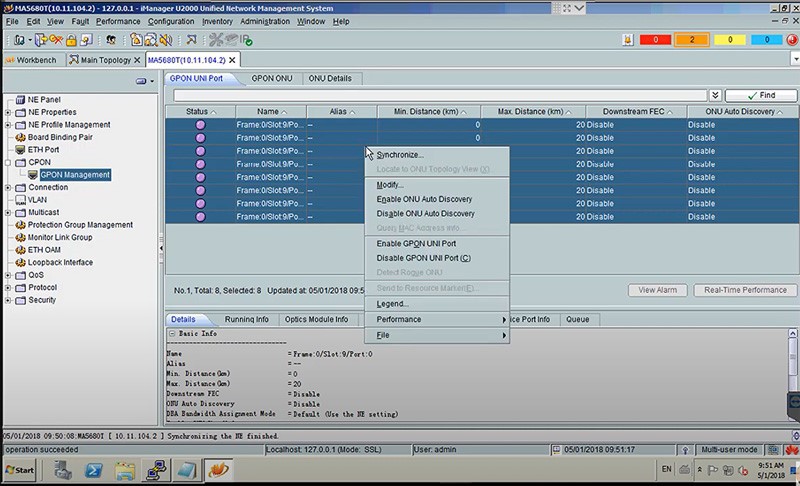
Traditional OLT:The network management system can only use a single brand, for example, Huawei can only use U2000 or NCE master network management system, ZTE can only use U31 network management system
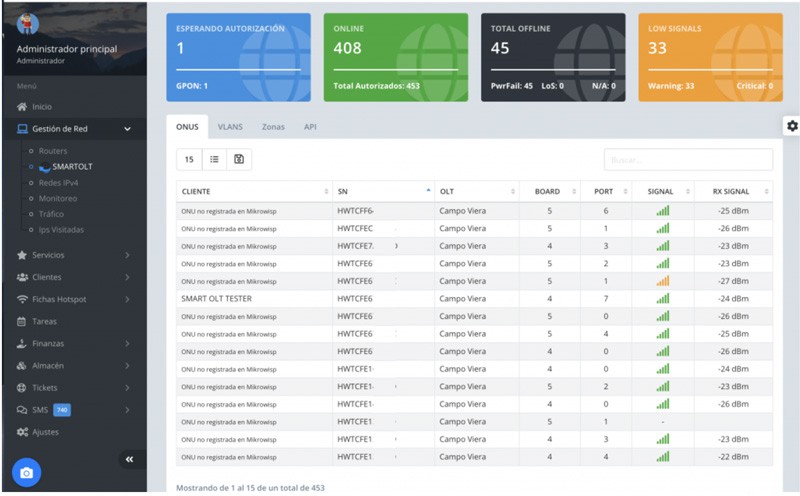
Smart OLT:Smart OLT's PSO network management system can be used on Huawei, ZTE, VSOL and other mainstream brands of OLT hardware devices.
Smart OLT
Built-in AI and machine learning capabilities enable automated network monitoring, fault diagnosis, and preventive maintenance.
Supports remote configuration and upgrades through software-defined networks (SDN) or centralized controllers, greatly reducing manual intervention.
Provides comprehensive API interfaces for easy integration of third-party operation and maintenance tools for unified management.
Example: Intelligent analysis can be used to detect fiber attenuation or connection anomalies and provide early warning of problems.
Traditional OLT
Depends on manual equipment monitoring and troubleshooting, which is inefficient.
Configuration and upgrades require on-site operations, which consumes a lot of time and manpower.
Functional modules are usually independent and lack automation tools, making centralized management difficult.
Smart OLT
Reduce labor costs through intelligent operation and maintenance, which is lower in the long run.
Fault warning and rapid recovery capabilities reduce economic losses caused by service interruptions.
More energy-efficient hardware design reduces energy and equipment replacement costs.
Traditional OLT
Requires more on-site support and manual maintenance, increasing long-term operation and maintenance costs.
Slow response to faults may lead to higher customer complaints and service losses.
|
Difference |
Traditional OLT |
Smart OLT |
|
Degree of intelligence |
Low |
High |
|
Management Way |
Requires manual configuration and management, relying on the operation of technical personnel |
Support automatic configuration and remote management |
|
Main structure |
Fixed hardware architecture, functions rely on dedicated hardware, static management |
Decoupling of software and hardware, support for virtualization and cloud computing, and dynamic management |
|
Ecosystem |
Bind to specific manufacturer's equipment, closed technology |
Based on open standards, compatible with multi-vendor equipment |
|
Compatiblity |
Single Brand |
Mutiple Brand |
|
Operation Level |
Medium~High |
Easy |
|
Apply |
FTTH/B/D |
FTTH/B/C |
|
Operation and maintenance efficiency |
Ordinary |
Very good |
|
Cost |
Very Expensive |
Economical |
The above are the differences between smart OLT and traditional OLT. We can see that the smart OLT system has the characteristics of flexible architecture design, intelligent operation and maintenance management, etc., and has great advantages in improving network performance and optimizing costs. In contrast, although the traditional OLT has a certain stability, it is also facing the rapidly changing market demand and complex business scenarios, as well as the increasingly fierce market competition and cost competition. Its limitations are also more obvious.
With the rapid development of 5G, Internet of Things and cloud computing, network intelligence has become a necessary development trend. As operators and enterprises, when deploying fiber optic networks, they need to fully consider network requirements, budgets and long-term development strategies. If you plan to use the smart OLT system or have other questions, you can always consult Asahikawa. We are an equipment operator focusing on fiber optic access networks and can provide you with comprehensive network operation and management strategies and solutions.